
Lander County Arrest Reports
The sheriff's Lander County Citizen RIMS arrest search doubles as the county's multi-day blotter. Same endpoint, different workflow. Instead of one date, you pick a range. The sheriff's system then shows arrest events recorded across all of them. The public map application defaults to seven days. The arrest database has no stated one-week cutoff.
This is not a sheriff-written roundup. Results arrive as structured event rows. A wider range can surface an event an earlier same-day check missed. It cannot unlock withheld, juvenile, sensitive, pending, or not-yet-filed material, and the sheriff warns the data may be incomplete or delayed.
Read the Lander County Blotter
Work backward from the period you care about. Save identifying numbers as you go. The arrest search tells you what event was entered, not whether someone is still in jail, whether a prosecutor filed charges, or how a case ended.
- Open the official arrest search and choose a start date and end date that cover the full period.
- Review event dates and times rather than assuming the page is ordered by booking completion.
- Record the incident, case, or original-case number shown with a relevant event.
- Compare the arresting-agency code and location. LCSO, NHP, ECSO, or another agency may be listed.
- Read every charge as an charge recorded at arrest, then use the correct court for filed charges.
- Check the incarcerated-person roster only when the question concerns booking or current custody.
The Arrested Today page fits one calendar date. It suits urgent confirmation too. A report spanning a weekend, holiday, or delayed entry belongs here, since the broader filter adds context without pretending a separate weekly feed exists.
Note: Save the exact date range and record number because a later search may return a different set of updated rows.
Lander County Report Fields
The arrest endpoint leans toward incidents. Its fields describe the action and the alleged offenses tied to one event. The jail roster answers a different question. The underlying response can hold more data than the visible table, so trust only the fields the live interface actually displays.
| Report field | How to read it |
|---|---|
| Incident number | The agency’s event locator. |
| Case and original-case number | Identifiers that can help trace connected agency records. |
| Arrest date and time | Recorded event timing, not necessarily jail intake time. |
| Block and street | The location string supplied with the event. |
| Action taken | A coded and described agency action. |
| Charge fields | Up to six codes and descriptions representing charges. |
| Name and demographics | Identity details that may include age, sex, and race. |
| Booking photo | Not displayed in the current official Lander County portal. |
Watch the arresting-agency field. Detention at the Lander County Detention Center does not prove LCSO made the arrest. Highway Patrol events near Battle Mountain still produce county bookings, and NHP, not the sheriff, keeps the incident report.
Official Lander County Date Range
The official arrest-search interface shows the county's multi-day date controls.
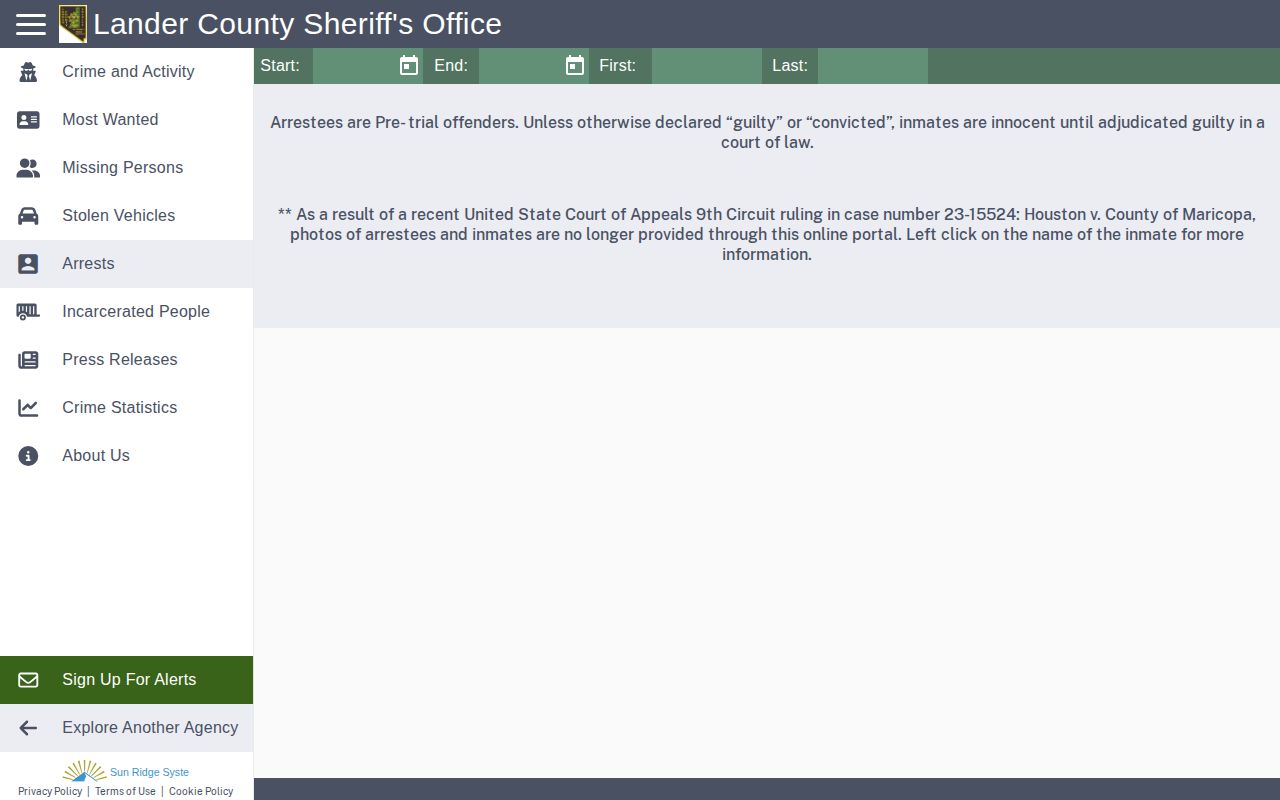
The live search governs the latest events and displayed fields.
Delayed Lander County Arrest Entries
No official source promises a weekend surge, holiday roll-up, or fixed publication hour. Arrest processing, booking, report review, and data synchronization run as separate operational steps. So an entry can surface days after the arrest. Widen the range across the days before and after your target period to lower the risk of missing a delayed entry.
A repeated name is not always a duplicate. It can mark separate events, amended data, a related original case, or another arrest entirely. One arrest can carry several charge codes. Identifiers tell the records apart. Never count rows as unique people. They are not a crime rate either. The arrest total is history, not an annual statistic.
Outside-agency events, highway contacts, holds, and repeat encounters explain how a small county accumulates thousands of rows. A sound trend needs a defined period, consistent coding, and an official statistical source.
News Is Not an Arrest Log
Regional and local reporting runs on events, not schedules. The Battle Mountain Bugle articles page offers article search and category filters, but the paper publishes no standing daily booking blotter or mugshot feed.
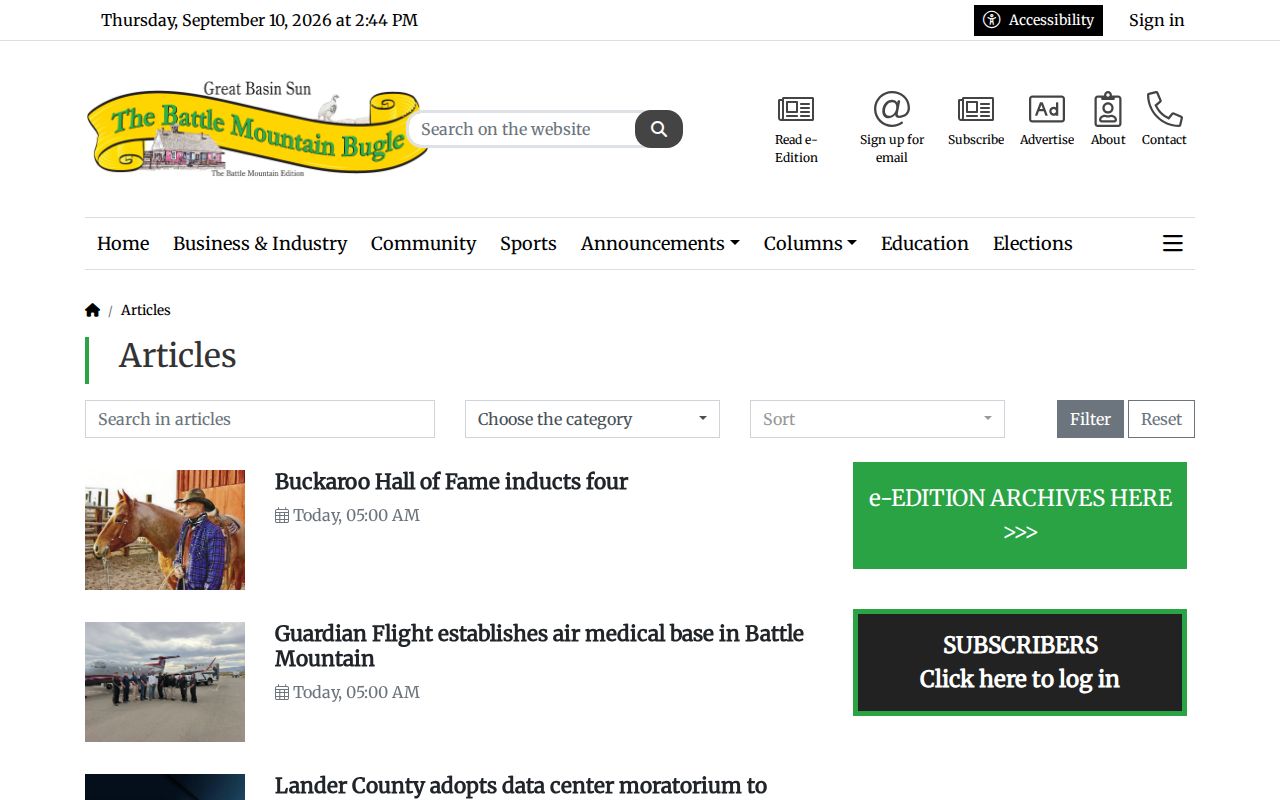
News can add narrative color to a reported arrest. Silence in the paper does not mean no arrest happened.
KOLO shows the same pattern. Its Austin standoff story credited the Lander County Sheriff's Office. A Battle Mountain-area pursuit report leaned on a Nevada Highway Patrol release. Note the news date and the named agency. Scene or file images are not booking photographs. The KOLO Austin report is one documented example of selected regional coverage.
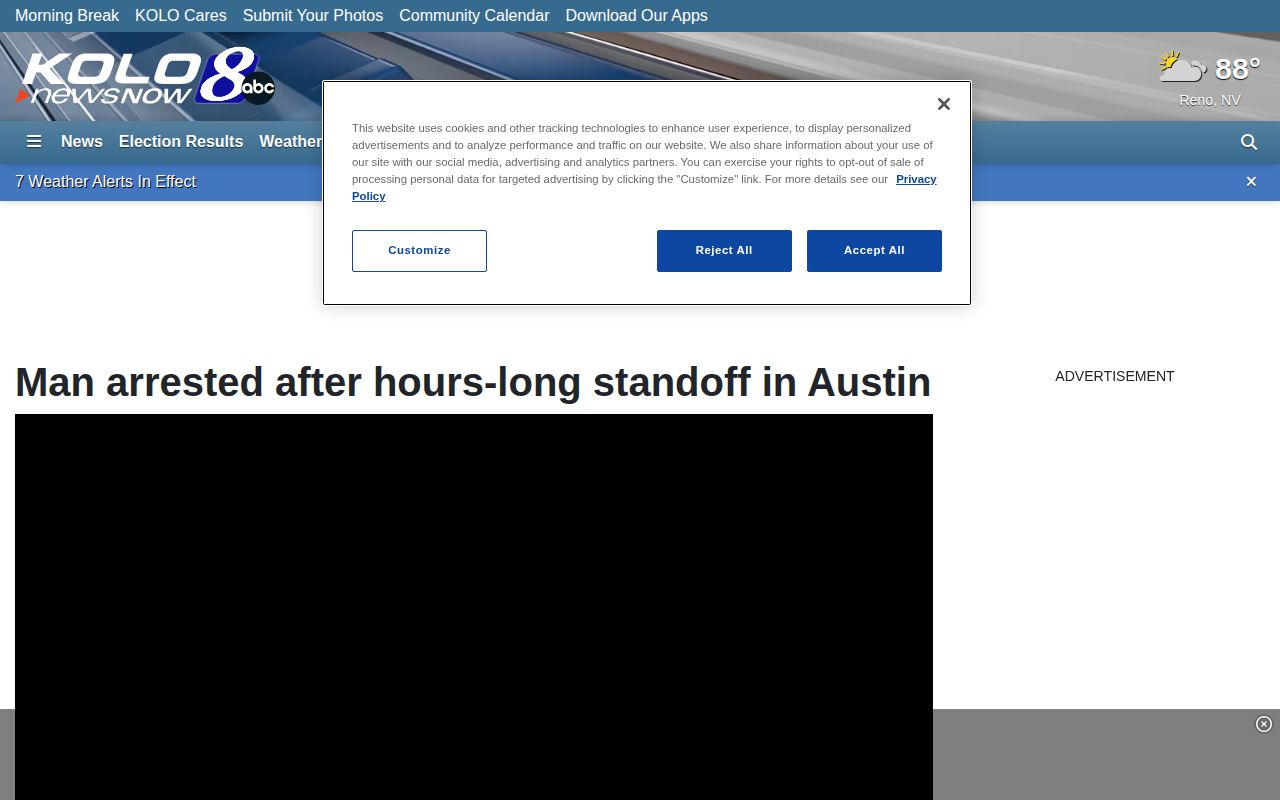
One reported event, not a full Lander County arrest report or photo archive.
Note: News selection reflects editorial judgment, so routine bookings may never appear even when they are present in official records.
Unofficial Lander County Listings
Private sites cover Lander County arrests differently. RecentlyBooked offers a rolling thirty-day view and makes its own refresh claims. Busted Newspaper sorts older results by page number. Mugshots.com holds at least one dated Lander County record. CountyInmateSearch displays a sync time for its data. None of these pages is the county's official keeper. Each can run late, repeat itself, or skip bookings entirely.
Start with the sheriff's official portal. It currently turns off arrest and inmate photos. So when a private page shows a booking photo, the image may be old. It may even be borrowed from somewhere else. RecentlyBooked's own county overview admits Lander County does not release mugshots. Yet some of its individual pages still display images tagged to the county. That contradiction resolves itself only one way: trust neither private claim as current.
A private listing never proves who is in custody right now. Check the sheriff's record first, then the court docket. A blank result on a commercial site does not mean an arrest never happened. No private outfit keeps the county's official arrest record.
Older Lander County Arrest Records
That seven-day window is a display choice, not a retention rule. Citizen RIMS reaches back through historical Lander County arrest data. The sheriff guarantees no fixed oldest date. When an older arrest is missing, contact the Lander County Sheriff's Office directly. Give the person's name, the approximate date, the location, and any incident or case number. Say whether you want paper or electronic copies. Ask for a cost estimate too. The sheriff's online fee schedule was still being built.
Nevada's local-government retention schedules offer clues, not certainty about one file. Incident reports, jail registers, release orders, rosters, and inmate files each carry a minimum retention period of their own. The custodian decides which series holds your item. A later schedule can change the answer. So can a legal hold, a transfer, or an archival decision.
Courts keep their own clerk records. For historical coverage, try Battle Mountain Bugle archives. UNLV's newspaper holdings and digitized Reese River Reveille issues work too. Those archives preserve past reporting well. None of them, though, forms a complete modern booking feed or a statewide booking-photo collection.
From Arrest Report to Disposition
An arrest report captures the agency's first move. Booking comes next, once a person is processed into detention. A court filing is a separate step. Its charge language may differ from the report. From there, proceedings can amend, dismiss, acquit, plead, convict, sentence, or otherwise dispose of the case.
- Blotter
- A chronological view of recorded law-enforcement events.
- Booking
- Administrative jail intake after an arrest or hold.
- Case number
- An identifier that may connect records but does not alone prove a court filing.
- Disposition
- The court’s resolution of a filed matter.
- Retention
- The period and rules under which a custodian keeps a record series.
The arrest report establishes one narrow fact. It marks a recorded law-enforcement event involving a named person at a stated point in time, nothing more. For anything after that moment, read the correct court docket.
Public Record Search
Sponsored Results